Trip To Singalila National Park : 'And The Mountains Echoed'
Upcoming elections, school tests, college final, buisness works and of course getting the leave sanctioned from the head --after overcoming/ leaving behind all these normal stuffs which most of the time stands as a barrier between our much awaited trip, we --the Wild Wights team removed the uncertainty and was all set to explore the Singalila National Park. Our team of 13members from all aspects of life consisted Sumit Chakraborty (our trip organiser), Prasun Kumar Chakraborty, Sarasij Chakraborty, Abhiroop Das, Ranu Das, Abhisek Chatterjee, Anasua Chatterjee Mukherjee, Arghya Chatterjee, Monojit Dey, Avinandan Hazra, Chiradeep Chowdhury, Sohom Sarkar and of course me. So hereby I would like to pen down the bagful of memories treasured in this trip:
12th April: We all gathered at Sealdah Station at about 8pm and boarded the 13147 Uttarbanga Express which departed at 9:45pm. The night journey was well spent with some snoozing, some chatting for whole night over music, some doing pranks --well, I will not get into those, lets move forward!
 |
| Wild Wights @Sealdah |
13th April: We reached NJP Station at 9:30am, collected our heavy luggage and after coming out of the station, found our two drivers waiting for us with two cars --one Sumo and one Toyota Qualis. Placing the heavy luggage on the top, we all settled down inside the cars with our camera bags with us. Our car zoomed towards Dhotre, our first halt before moving to Singalila National Park. The distance from NJP to Dhotre is about 115kms and would take about 3-3.30hours to reach there .The intoxication of the wind and the snowy paths towards Dhotre soon mesmerised us. Two Khalij Pheasants (Lophura leucomelanos) crossed our way before we could take a well glance at them ---our first welcome to the reign of green mountains!!
We reached Dhotre at about 4:30pm. The journey took about 5 hours as we came via Mirik and also halted at a few beautiful places to capture some pictures.It was already drizzling with the chilly wind, the darkness gradually seeping in, the faraway layers of mountains blurred.Without wasting time, we quickly collected our luggage and got inside our pre-booked cottage ---the three female members including me in a room with three single beds and the male members inside their dormitory in another attached cottage. The rest of the evening was well spent with all of us gathering in the dormitory and chatting.
 |
| Sumit Chakraborty |
 |
| Ranu Das & Anasua Chatterjee |
 |
| devilish smile:Sarasij Chakraborty |
 |
| few shots taken in the afternoon |
14th April: No matter how the biting cold made us creep inside the double blankets, we sprang up on bed hearing a blurred commotion about the Kanchendzonga bathed with the first sunlight and quickly ran towards the window to catch a glimpse of this marvellous moment.
 |
| Wild Wights @Dhotre |


After having tea and all our luggage well straped, we were all set to trek to Tonglu (10074ft). It was a 5km trek through thick Rhododendron forest (although we saw very less number of this beautiful Rhododendron flower en route). Our team got divided into small groups according to our stamina!! Those with more stamina would trek fast and halt less and those with relatively less stamina, some first time trekkers too (like me, Monojit, Arghya etc), would trek slowly, steadily, consistently and halt more. Only one bottle of water for each seemed not at all enough, moreover we were getting exhausted in the mean time and start panting. So some of us started having one capful of glucose powder (which I carried) and I would also have a drag of amber from a small container (which Monojit carried). This was proved very very helpful. Also the cool breeze kept cooling us. Wearing soft sneakers, I found it quite tough to trek; even stepped over a few times. A good trekking shoe was very important, but I still managed. Well, all these things were quite enjoyed in the strenuous trek because all of us got along pretty well. We kept taking pictures of butterflies, birds, landscapes and our team members too and continued to converse about various things ---the tiresome trek seemed pretty entertaining that's why.
 |
| Prasun Kumar Chakraborty |
 |
| Prasun Kumar Chakraborty, Arghya Chatterjee & Monojit Dey |
 |
| Sarasij Chakraborty & Abhisek Chatterjee |
 |
| Abhiroop Das |
 |
| Monojit Dey |
We reached the entrance of "Tonglu Medicinal Plant Conservation Area", an immense satisfaction after completing the trek embraced us. I did not check the time. A huge THANKS goes to our trip-organiser Sumit Chakraborty, who in spite of a fractured ankle trekked to Tonglu first and arranged all others rooms and lunch. Our other teammates were waiting for us, they helped us placing our luggage in our room at Raju Bhaiya's cottage. After taking some rest over jovial conversation, we all sat for lunch.
 |
| Trekkers' Hut |
The mist gradually covered the area in the afternoon (early evening). Strong chilly wind made it hard to stand on the cliff, but we all stood there taking various shots of the sunset. one shot by Chiradeep Chowdhury is given below:
The rest of the evening was well spent with usual chatting, leg-pulling and of course placing hands over the steam! Me with only a sweatshirt found it difficult to stop myself from shivering. But the hot meal proved to be quite helpful.
15th April: It was half past 3 when I woke up at night (needless to say, the magical moonlit night, the chilly wind is very stubborn to leave you awaken till late) and found my roommate Ranu Das (Ranu di, that's what I call her) also awaken and staring outside. Seeing me woke up, she excitedly asked me to go to her bed and catch the authentic scenario of Kanchendzonga glorified by the moonlight. It made both of us speechless, we just sat down and kept on drinking the beauty as much as we could. I felt an irresistable urge to go out and catch a more open view but did not do so, because first of all Ranu di would not let me go out at that point of time and another reason was that even I did not want to waste a moment keeping my gaze away from that incredible sight.
That morning, the Kanchendzonga looked more glorious ornamented with the tender sunlight. Seeing the Kanchendzonga first time in your life, that is something out of the world....it was my first time! Our enthusiastic photographers went out in the wee hours to capture the wonderful moments.
 |
| Some shots taken by Abhiroop Das (Tubai da) and Arghya Chatterjee |
We came out of the cottage early and in small groups moved towards Tumling, 1.1km from our Tonglu base. The road was very uneven and our trip organiser Sumit Chakraborty, who had fractured his ankle just about two months before the trip, found it very painful to walk, though his always-so-enthusiastic face said that it was no hard task for him! We took pictures en route and reached the border of Nepal, from there the region of Nepal starts. We got inside a restaurant and had tea. The lively village life as well as bird-photographs was well captured by our group-mates.In the mean time another small group of our team had turned up. We waited for all our team members to turn up and after that we headed towards Shikhar Lodge, a hotel well known in this place. A number of trekkers-tourists were there outside. We had our breakfast and also some of us got our mobiles and camera batteries charged (as there is no electric supply in Tonglu, the charge of mobile and camera batteries got almost drained out).Then we moved towards Meghma, 1.2km from there. Here we found a great variety and number of birds (White collared Blackbird, Citrine Wagtail, Blue-fronted Redstart etc.).


 |
| Stonechat (Male) |
 |
| Blue-fronted Redstart |
 |
| White Collared Blackbird (female) |
 |
| Sumit Chakraborty |
 |
| White Browed Fulvetta (male) |
We descended towards Meghma. The magnificent blue sky with cottony clouds, the scenic beauty of the route and the chirping of bird penetrating the silence ---all of these made our journey utter enchanting. Suddenly at a place beside the road we spotted about 40 White-Browed Fulvettas (Alcippe vinipectus) fluttering and chirping on a tree but found it really hard to capture full body picture of them as they were very agile and played hide n seek between the leaves and the branches. The whole lot kept flying from one tree to another and we also kept on trying steadily to get some good shots. Ultimately they all flew away. We felt utterly exhausted by this but soon composed ourselves and moved forward. A number of Himalayan Griffons were flying above and below and we all went click-click to get a few flight shots. Then me along with Sarasij Chakraborty and Sumit Chakraborty decided to go down to an wasteland where those Griffons were sitting, some taking flight, some casually moving. But before we could capture a few moments of them, the hill-dogs which were coming along with us in the trekking, came running and barking aloud, scaring the whole lot of griffons to fly away. In utter despair we came up and headed towards our final halt at Meghma. Beside a monastary, there was a restaurant. The army barracks were down the road. We had tea, some of us had a quick visit to the monastary. Here we got full network on mobile and were able to contact our families.


 |
| Beneath the blue, there will be my dream palace |
We now moved up to Tonglu along the steep trekking route, some of us took shortcuts by quickly climbing the steep walls of the cliff. It gave much pressure to our legs but after all who will ignore shortcuts when you have long way to go? On route we found a milestone which said "Tonglu, 1km". We felt excited as that meant we had to cover only 1km or so to reach our place at Tonglu. But to our utter disgust, we covered almost two times the distance we had trekked before seeing that milestone, but the entrance gate of the Singalila medicinal plant area was found nowhere nearby. That meant the milestone was a mere bluff or so! Anyway we had nothing to do but steadily keep climbing. We halted a few times to gather our breath and again trek up. The clouds were slowly moving towards Tonglu and a chill was felt, so we put on our jackets and sweatshirts. In middle of this, the drizzling started with tiny ice particles falling down. We immediately stuffed our cameras inside our bags or covered them under jackets. A photo taken by Chiradeep Chowdhury is given below:

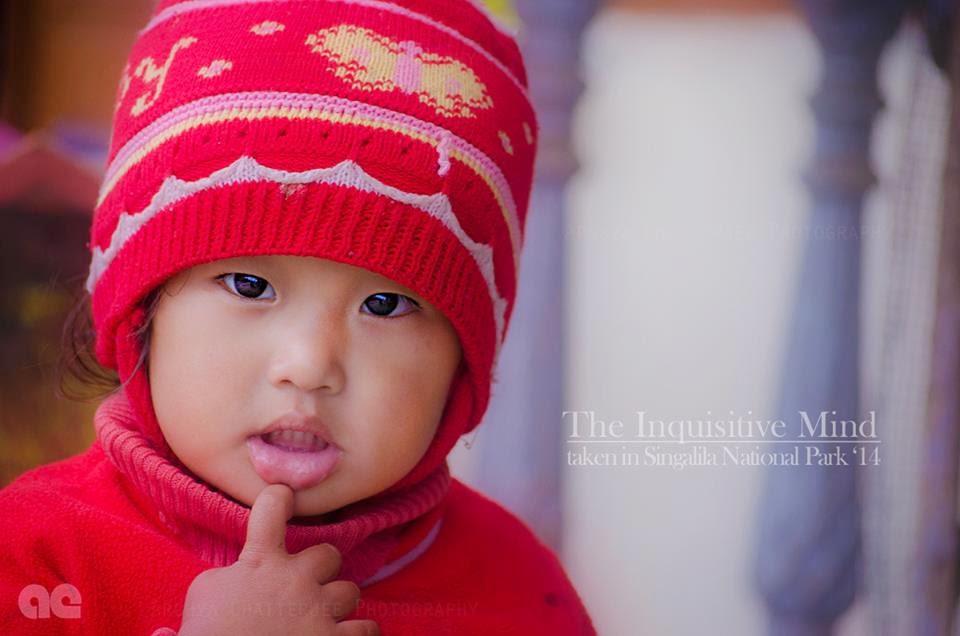
That afternoon after lunch, I got to smile wholeheartedly after a long time, courtesy the two cutie innocent children of Raju bhaiya, we stayed at their place. With them I felt as if I had gone to my childhood days, I played with them, the two girls kept on telling me stories about their family, their life, their late grandfather, pets, school, their village and took me to one cliff to another holding my hand ---I felt so light, so special. Our light moments gave two enthusiastic photographers Sumit Chakraborty and Sarasij Chakraborty the chance to capture their portraits. The whole evening was full of music, sung by our teammates and at the end of the day it filled my mind with immense tranquility...
 |
| Praneeta-- taken by Sumit Chakraborty |
16th April: The next day our team decided to explore the inset of Singalila National Park via Kalpokhri-Garibas. Me as well as Sumit Chakraborty did not feel like going due to physical weakness and henceforth explored the nearby places. We got White Collared Blackbird, Olive-backed Pipit, Accentors etc. along with landscape and portraits. Our rest of the team however came back at about 12:30pm with a huge photo collection of landscape,people and of course birds (Rufous Vented Yuhina, Rufous Gorgetted Flycatcher, Verditer Flycatcher, Oriental Turtle Dove etc).
 |
| White-collared Blackbird |
Our pre-programme of campfire was laid by because of the rainfall along with ice particles. The evening went on like the earlier two evenings, just a bit of melancholy creeped in as we were to be leaving the next morning.
17th April: We all woke up early and gathered outside to get our group-selfie having the Kanchendzonga in background.
One by one we started trekking down to Dhotre. As we then knew the few shortcut methods, so the route which we covered while trekking up to Tonglu on 14th April in about 1hour, we covered that in about 20minutes this morning. Our ever-so-agile teammate Sarasij Chakraborty in this shortcut trek slipped once and got serious strain in his ankle. We halted at a meadow, his ankle was treated with volini and Ranu di bound crepe bandage around the ankle. Some of the teammates walked about nearby to capture some photographs of birds.
 |
| photos taken by Chiradeep Chowdhury |
 |
| Monojit Dey resting |
Our team again broke into small groups maintaining the same stamina-rule we had on 14th!! Trekking down seemed more strenuous for me (with soft sole sneakers and my shivering knees seemed weak) as well as Sumit Chakraborty (with his fractured ankle). But with other members of our group we moved forward. Our teammate Soham Sarkar got the most variety of birds in this trip and he kept on spotting birds en route and we would gather to catch a glimpse. Same procedure of halting in between was adopted this day also. In the middle of one halt, our team leader Sumit Chakraborty got lost without telling me and Arghya Chatterjee while we were resting. A few minutes later I understood that he had gone and immediately asked Arghya to get up and move forward hurriedly so that we can find him. We trekked down quickly and found the other two Chakraborty duo --Prasun Chakraborty and Sarasij Chakraborty, but Sumit Chakraborty was nowhere around. They told us not to worry and we halted there for some minutes. While trekking down, we found a variety of Sunbirds, Accentors, Scarlett Minivet, White-browed Fulvetta etc.

 |
| Sohom Sarkar & Arghya Chatterjee |
 |
| Scarlett Minivet |
 |
| White-browed Fulvetta |
 |
Sumit Chakraborty (before getting lost)
|
At about 11am, we finally reached Dhotre and had 'road-tea' (yes, we all tired sat beside the road where we were served hot tea). From there we came down to the village market and there at last we spotted Sumit Chakraborty, felt relieved. Everyone got inside a small restaurant, other teammates were waiting there. We were served hot Momos, everyone famished ate as quickly as possible!
Our cars were parked outside and we all settled inside, everyone feeling down for leaving the serene lap of nature. Those five days were full of life, far from the din and bustle of town, rejuvenataed our mind and body, filled our heart and soul with ecstasy, leaving all the complications we were dipped into euphoria. We reached NJP at about 4pm via Mirik, coming from the 5degree cen temperature, the heat was burning us. We freshened up and took rest inside the waiting room. At 8pm we boarded the 12344 Darjeeling Mail and the rest is just so insignificant ---again getting into the monotonous life the next day.
Some amazing shots taken by our teammates are also given:
Now thanks a ton for going through this really long blog full of pictures taken by not only me, but my superb photographer friends too (I really doubt people will wait for all the pictures to load and read unto the last, I mean this line,but nevertheless those who did, thanks again! )


.jpg)

.jpg)