Layers And Shades

Layers And Shades
Layers And Shades

Sunday, 7 September 2014

PONDICHERRY TO GOLDEN BEACH, CHENNAI

                  PONDICHERRY  and  VGP GOLDEN BEACH, CHENNAI
             It was a bright day at Pondicherry. We got up early and after finishing our breakfast headed to Sri Aurobindo Ashram, the famous spiritual community established in the Indian territory of Pondicherry (now Puducherry ) by Sri Aurobindo on 24th November, 1926. At that time there were a few disciples staying with Sri Aurobindo. Aurobindo subsequently decided to withdraw from public view for continuing his spiritual work and handed over the responsibility of the sadhakas (spiritual aspirants) and the ashram to his spiritual collaborator, "The Mother", earlier known as Mirra Alfassa.  


WAVES AT PONDICHERRY BEACH


                     In the early history of the ashram, there was a regular routine. At 6am everyday, the Mother appeared on the ashram balcony to initiate the day with her blessings. Sadhakas (spiritual aspirants), would have woken up very early and completed a good portion of the day's work including meditation and then assembled under the balcony to recieve her blessings. 
                     
                     As the ashram grew, many departments came up and were looked after by the Sadhakas (spiritual aspirants) as a part of their sadhana (worship): the offices, library, dining room, book/paragraph painting, workshops, sports/playground, art gallery, dispensary/nursing home, farms, dairies, flower gardens, guest houses, laundry, bakery etc. The heads of the departments met the Mother and took her blessings and orders. She would meet the Sadhakas individually again at 10am and in the evening at 5:30pm, she would conduct meditation and meet the Sadhakas.

                    In addition, four times a year Sri Aurobindo and the Mother used to give public Darshans (spirirtual gatherings where Guru bestows blessings) to thousands of devotees gathered to receive grace.


                           Today, Pondicherry has become an important  destination for spiritual seekers as well as tourists. Thousands of visitors from all over the world come to the ashram. When we entered, it was as if we had entered in another world, where peace prevails, where one can immerse all the sorrow and re-awake. Not only the Indians but huge number of foreign tourists were sitting on the mosaic-marble floor, deeply engrossed in spiritual books, pamphlets, some in deep thought or meditating with eyes closed.  A sanctum was nearby, with a small water body --flower petals scattered over. What a neat, tidy, peaceful, serene ashram it was! We saw the marble statue of Mother and Sri Aurobindo, in front of which, the devotees were sitting and meditating. The rooms were clean, calm and so was the library. None talked loud, people checked books, pictures, pamphlets, subscription forms etc.

                    The visiting hours for the visitors are from 8am to 12noon and then again from 2pm to 6pm. The ashram has no branch, the only one is at Pondicherry. Here is the address for your convenience : Marine St. , White Town, Puducherry 605002.  Contact no. - 0413 223 3604

                    Camera is not allowed inside or near the Ashram, so I could not click pictures. Pondicherry is anyway a very picturesque town with Portuguese buildings and beautiful lanes. After visiting the Ashram, we went to the beach beside, stayed there standing and enjoying the salty wind and sound of mild waves....then headed towards Chennai. 


                        The VGP Golden Beach is located on the Bay of Bengal in Chennai, Tamil NaduIndia. It is a major tourist attraction in Chennai. It is situated in the East Coast Road from Chennai to Cuddalore via Pondicherry. 


                      One of the most endearing attractions is the surging Bay of Bengal --a private, velvety beach with silvery sands --on the Marina, the world's second longest beach. You would hardly find any where else, an amusement park that has an enchanting sea at the backdrop.


                    The breaking of the waves and the whistling of the winds are music to the ears. It's also a safe beach where one can go for a bath or a short swim, come ashore and have a fresh water shower to cleanse. Adequate services are provided to help people enjoy.

Monday, 1 September 2014

KANCHEEPURAM -- MAHABALIPURAM

                        A VISIT TO  KANCHEEPURAM- MAHABALIPURAM

                           It was about 9:30am when we reached Chennai by the early-morning train from Bangalore. The time was the last week of October. our guide Arjun welcomed us at the station and we headed towards Mamallapuram. Mahabalipuram also known as Mamallapuram is a town in Kancheepuram district, around 60km south from the city of Chennai in Tamil Nadu .
By the 7th century, it was a  port city of South Indian dynasty of the Pallavas . It has various historic monuments built largely between the 7th and 9th century and has been classified as a UNESCO World Heritage Site . So needless to say, I was overwhelmed with excitement for the trip, but unexpectadely the rain started tremendously pouring water to my excitement! But may be the nature took pity on our excitement and after 15-20 min there was bright sunlight

THIRUKADALMALLAI , KANCHEEPURAM

                     Our first stoppage was Thirukadalmallai , a temple dedicated to Lord Vishnu , built by the Pallava king in order to safeguard the sculptures from the ocean. After building the temple, the remaining architecture was preserved and was not corroded by sea. The large entrance gate is the main attraction. A number of small tented shops were there outside the temple. Here a few cows with surprising look caught my gaze --the cows were large in size and had horns of about 3ft long. The foreign tourists were very much excited clicking pictures of those cows. A small crowd had been formed.

SHORE TEMPLE, MAHABALIPURAM

                         We had our lunch on the way to Shore Temple and Five Rathas (Pancha Pandava Rathas). The Pancha Rathas or Five Chariots are five monolithic pyramidal structures (Rathas), literally Chariots named after the Pandavas (Yudhishthira, Bhima, Arjuna, Nakula and Sahadeva) . Beside these, there is also a chariot named after Draupadi . These sculptures are complimented by some enormous stone animals including a large elephant. Dating from the 7th century, the sculptures were sculpted from the craved stones from the cliffs of the shore of the Bay of Bengal . In the Pancha Rathas, each Ratha is sculpted in a different style. The different sculptures, some half-finished, may have been examples of different styles of architecture, probably practised on by young students. An interesting aspect of the Rathas is that, despite their sizes, they are not assembled --each of these is carved from one single piece of large granite stone. The carvings are instance of the hard labour of hundreds of years. 


SHORE TEMPLE, MAHABALIPURAM


                   After the Five Rathas, we headed to the Shore Temple , the oldest structure in the area. Built in c.700 A.D. it is spread along the Bay of Bengal with the the entrance from the western side away the sea. 


BAY OF BENGAL TO THE EAST

                                 Unlike Mamallapuram's other monuments, the temple is not carved from rock, and the bulk of the current structure is a reconstruction after it was struck by cyclone. Recent excavations have revealed new structures here. 


VIEW FROM SHORE TEMPLE

                                   It's not particularly large and the carvings have been badly eroded by the salty wind and the tide, but this adds to the sense of tranquility. The area around the temple consisting a landscaped park, lush greenery and hordes of souvenir hawkers at bay enrich the beauty of the place making a huge tourist attraction.


FOREIGN FIGURES

                        The drizzles had just started then and we took shelter under a tree but that was just for a few minutes, as the rain had ceased. We came out of the shade of the tree AND was spellbound to see the rainbow formed over the sky, beneath there was the gushing deep blue sea!  It was a moment treasured...

WHERE THE RAINBOW FANCIES ON THE DEEP BLUE SEA

                  But anyway, we had to rush back to our car as the sun was biding adieu and the evening was gradually setting in. We had to cover two more places --Arjuna's Penance Bas-relief and Krishna's Butter Ball, about which I had blogged last year, when I had just started blogging! Here is the link http://photoshreya.blogspot.in/2013/07/krishnas-butter-ball-one-day-at.html


Monday, 14 July 2014

INDIRA GANDHI MEMORIAL TULIP GARDEN

                      INDIRA  GANDHI  MEMORIAL  TULIP  GARDEN,  SRINAGAR 


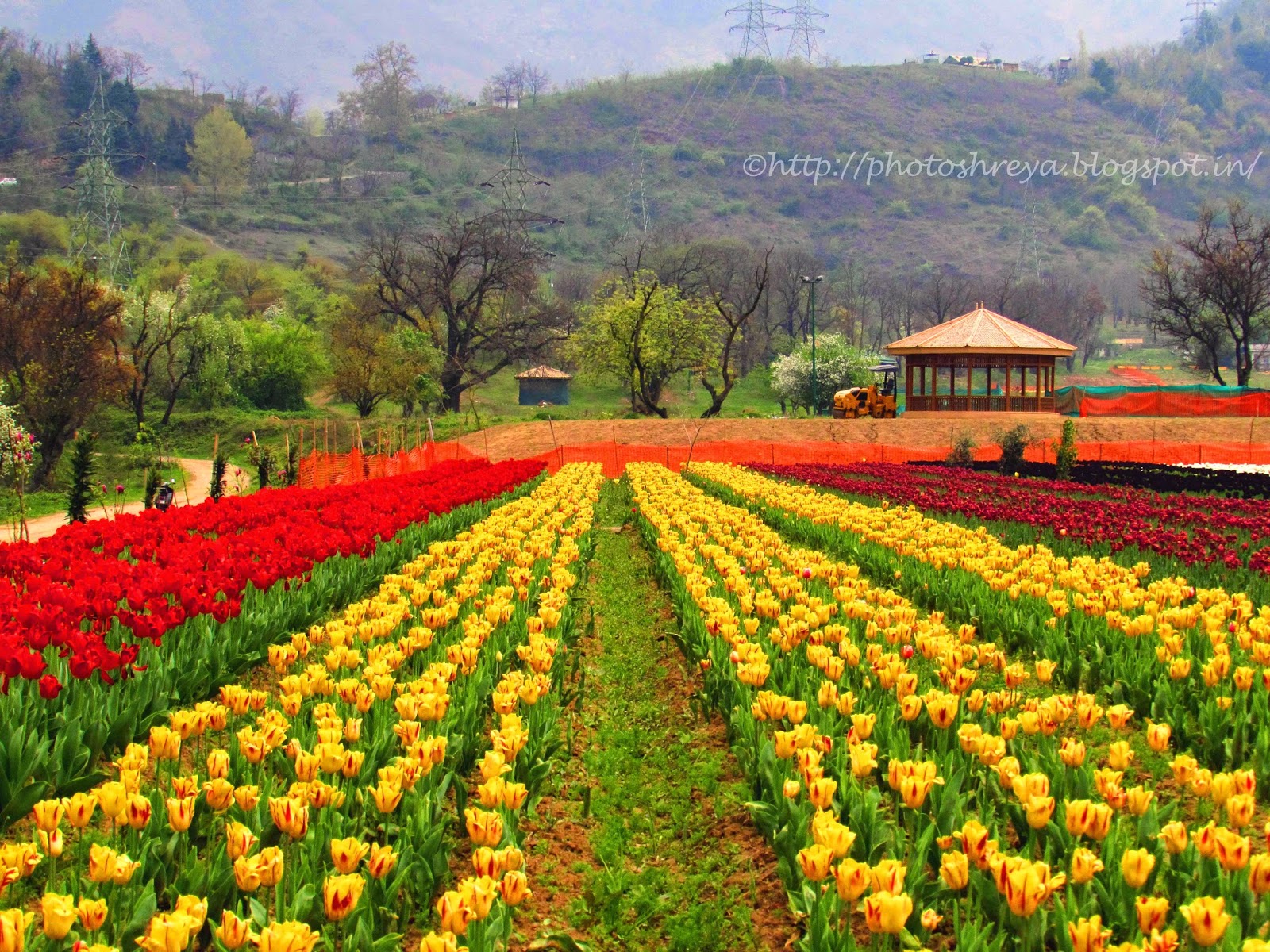
Indira Gandhi Memorial Tulip Garden previously named as Model Floriculture Centre, Sirajbagh, Chashmeshahi, Srinagar, is the largest Tulip Garden of Asia spread over an area of about 12hectares. it is situated on the foothills of Zabarwan Range with an overview of picturesque world famous Dal lake.

This garden was conceived, conceptualised and created by Mr. Ghulam Nabi Azad, the then Chief Minister of Jammu and Kashmir in the year 2006-07 with the aim to boost floriculture and advance tourism in Kashmir Valley.


In the month of April, this year I got the golden chance to visit this vast valley of tulip in the Jammu and Kashmir trip. The morning started with the scorching sun, and it was the day for sight-seeing around Srinagar. Tulip Garden was the first destination and so excitement was on the highest peak!  The famous film Silsila, where the suave Amitabh Bachchan and the ever-glamourous Rekha thrilled us with the song sequence "Dekha ek khwab" ; it was a song before my birth but thanks to my parents, I got to watch the film and the song of course a numerous times. Every time my mom would say how exquisite the tulip garden is and how she wants to visit the valley. So obviously it was in my travel wishlist too and here I was visiting this garden, with my parents!


Okay, so we entered the garden after taking tickets 40 rupees per head. AND as soon as I entered, I was like OH MY GOD! the valley is stretched faraway and you will wonder where it ends. You will find yourself encircled by tulips and tulips everywhere. I started clicking immediately but the I remembered that the ticket is valid for only half an hour, so I had to hurry otherwise I could not complete the full garden. I headed forward and was amazed to see the burst of colours all over. No, not a red carpet to welcome you, but thousand coloured carpets are spread by these tulips to welcome you whole-heartedly. I was confused about which one to click and which one not! rows after rows of flowers were tossing their heads as if to welcome to their region.


A number of  gardeners were there to plant the saplings, water them, cut the weeds, and take a lot of care of the bloomed flowers which are the center of tourist attraction. they do not notice the tourists as they are always busy caring the large garden. 

One of the surprising thing was that none was tearing the leaves or plucking the flowers. The reason may be that they wanted to show respect to the heavenly creation of nature OR may be that they did not want to give 500 rupees as a compensation/fine for tearing or plucking flowers-leaves. Well, while roaming about I saw a baby running towards a tulip flower to pluck it and his mother (who was busy talking with her sister before)  came running and screaming at him not to pluck that flower. It was so damn funny to see how people are so afraid of giving fine LOL :)


There are green grass carpets spread in the middle of the rows of flowers. People roamed about there, some entered inside the rows of tulips and got clicked (of course with tender care so that the flowers don't get affected). Couples, school children (class-bunkers!), honeymoon couples, families and also some crazy-minded people like me were roaming, clicking, some even asking for clicking pictures of them. It was the pick-season of flowers and so huge number of tourists turned up. The garden remains open only for 2-3 months, because after that the flowers get dried up, the monsoon sets in and before that period the snowfall does not allow flowers to bloom. I noticed that some flowers had already started to dry up. Even the travel guide Raju told that in his career of about 10 years, he saw the tulips for the first time. So no doubt I was very lucky to catch a glimpse of the great valley of tulip flowers. 


The different flower shrubs beside the tulip-rows accentuated the beauty apart from the tulips. Besides Pine, Deodar, Spruce, Willow, Maple trees give shade by the rows of tulips. The Apple trees were in full bloom, fully ornamented with white flowers. There were rows of table-chairs and cement slabs where the tourists and visitors were taking rest, some taking food. As it was really scorching heat, so I stood under a Maple tree, it felt soothing after roaming and clicking under sun. There is also a floriculture centre beside the garden which provides saplings, seeds, fertilizers etc . One gets to know a lot more about how to plant Tulips and grow them from there. The Palm Swifts, Barn Swallows, Himalayan Bulbuls kept fluttering over the flowers and Golden Eagles and Shikras kept flying above with sharp look beneath.


Every year, Spring Tulip Festival is held here at the Tulip Garden. This year it was held from 12th to 14th April. it was a grand fest, where celebrities turned up and made the Spring Tulip Festival 2014 a great success. 
You can check the following links for videos of the tulip garden:


Monday, 16 June 2014

JOURNEY FROM LEH TO KARGIL

                          LEH  TO  KARGIL : THE  ENCHANTING  JOURNEY


After spending a day at Leh covering the sight-seeing, we headed towards Kargil. The driver, a jolly and quite obedient one, would halt near beautiful landscapes so that I could take satisfying snaps. No need to mention that he had already understood how much a photography-crazy I was! I in fact was obliged to this jovial behaviour of him. The route from Leh to Kargil would take about 7-8 hours. We were to stay there at Kargil for the next day and then head back. 

The smooth NH1 stretched over Leh is very popular, number of films were shot there. The sultry, rough weather of Leh may put you down but the journey never will...It is one of the most beautiful route I have seen. All the way I witnessed a number of bikers with Royal Enfield --everyone's dream bike! And no doubt you will experience the beauty of Ladakh more closely and profoundly  if you hire a bike and zoom off along the road. You can halt wherever you want, you can take pictures whenever you want. 


There was also a "Magnetic Hill" en route. The driver pointed that out and left his feet from the accelerator and hands from steering, and with utter surprise the car was moving spontaneously with only the magnetic force. The picture below was taken beside the Magnetic Hill, its on the left side.


The next spectacular landmark was the place where the Sindhu and Zanskar riverflow gets blended, you can easily distinguish the two different colours of the different rivers. I had already taken a few shots from the running car but the driver halted beside the road and told me to get off the car and take some clear shots "yahan se acche photo aayenge" (you'll get good photos here). A few cars were parked nearby and tourists were standing at the edge of the road to capture some beautiful shots. The colour of the Zanskar river is bluish green while that of Sindhu is yellowish grey. I captured a few shots and got on the car...


The Zanskar river was a constant companion throughout the route...Afterwards it was crystal green, the reflection of the grey-brown cliffs fell upon the riverflow. Nothing could have been more magnificent than the blue sky, green river and grey cliffs --a perfect combo.


The route offers you both snow covered peaks, shaded grey cliffs, patch of greenery and the companion of riverflow in one pack. It's worth a visit to Ladakh.


There is this amazing structure en route called "Moonland". This sturucture is like plateau, with slopes and it is said that on full moon nights, the moon beams fall upon them making an exquisite beauty.


The route offered some different shots too like: 


With lots of pictures taken en route, and a feeling of peace in my mind, at last reached Kargil....


A road trip I remember....