Layers And Shades

Layers And Shades
Layers And Shades

Tuesday, 3 May 2016

Deoria Tal

                          DEORIA TAL THROUGH THE MYSTIC SARI VILLAGE


Gorging onto chocolate croissants with quick slurps of steaming tea gave me ample moments to marvel at the lush green canvas of the picturesque village, sometimes stair cased, sometimes sloppy below the road. We had started at about 6 in the morning from Makkumath with Yashpal Singh Negi as  our guide, covering a good distance by road shaded with pine, oak and birches almost blocking the view of the sublime blue sky and passed the snow-clad mountains as the sun emerged sprinkling rays over the peaks. We had halted here at Sari Village to grab hasty bites of breakfast and to dump our warm garments inside the car before kicking off our trek to the mesmeric Deoria Tal residing in the lap of Garhwal Himalayas as per scheduled on the last day of our Uttarkhand trip.

SUNBEAM SWATHED SNOW
THE LOWER REGIONS ARE STILL IN DARK
JOURNEY STARTS AS OUR CAR SPEEDS THROUGH THICKETS
The 3km gravel trail laden through the Sari village welcomed with the alpine trees as well as the thorny shrubs. Sari village is a small and remote village based in Rudraprayag district near Ukhimath at a height of 6554ft. Meanwhile it is the outlandishly romantic base camp for the majestic Deoria Tal at a height of 7800ft. The first 1km or so is not strenuous enough even for the first-timers, however one can still hire pony or mule on the way. We could get breaks from continuous trek at regular intervals as Negi would spot Himalayan birds fluttering on the branches of the trees and the shrubs.

THE BIRDSEYE VIEW WHILE ASCENDING
WE SAT DOWN TO DRINK THE BEAUTY
MADHYAMAHESWAR  OR MADMAHESHWAR TEMPLE
WE LEFT BEHIND THE TEMPLE AND GO ON TREKKING UP
Beautiful Rosefinch (Carpodacus pulcherrimus), Spot winged Rosefinch (Carpodacus rodopeplus), Himalayan Woodpecker (Dendrocopos himalayensis), Asian Barred Owlet (Glaucidium cuculoides), Rufous breasted Accentor (Prunella strophiata) etc enchanted us throughout the trek along with Lammergeier or Bearded Vulture (Gypaetus barbatus) hovering high over our heads. A stone temple namely Kedar Temple stands erect on the way, with the hymns enchanted on the loudspeakers. The birds seem to be adamant with the sound system and its relieving to see those hovering in flocks freely.  The temple stands as a landmark from where about two and a half kilometers of steep trail has to be conquered before experiencing the aesthetic delight of standing beside Deoria Tal. Sudden jerks of exertion engulf us as the uneven path turned steeper and grueling. Quick bites on chocolate bars as well as moderate sips of water helps in acclimatization for a few minutes and one can inhale more oxygen thereon passing amid the dense Rhododendron and Oak forests. The Rhododendrons were budding as the full bloom time was ahead in March-June.


LAMMERGEIER OR BEARDED VULTURE
BEAUTIFUL ROSEFINCH (FEMALE) TAKING OFF
BLACK THROATED TIT
VARIEGATED LAUGHINGTHRUSH
STREAKED LAUGHINGTHRUSH
The summer sun in Deoria Tal trek remains warm and pleasing, regarded as the best time to visit the lake as the strong chill is reduced and one can experience the euphoric delight of the full bloom Rhododendron forests on the way. After that the increase in landslides and hence road-blockage causes hindrance to the trek, so it is recommended to avoid during that time. Spring months from mid-September to late October is also considered a great time to visit alongside the summer months because the winter starts to set in at that time and the chill is not beyond tolerance level with the charming weather and the warm sun favouring the trekkers. Finally it is recommended to bypass the winter months i.e. from November to February as the extremity of cold and snowfall blocks the trail. Meanwhile it was the December end while we were striding across the stony trail. The last 1km almost churned my body; the glaring sun sucked all the energy leaving me dehydrated, exhausted and exasperated with the sweat that rose beneath my cotton clothes. With the increase of height, the oxygen level reduced to some extent which made us panting. But snow had also increased to a great level with the increase of height and I left a sigh of gleaming relief. The glistening snow, the village huts scattered here and there underneath the slope and the layers of mountains covered with layers of clouds left me simply speechless. The breeze mixed with the wild scent had casted a spell on me. We crossed the plump reddish-cheeked village lashes and wrinkled skinned old women who were returning from the uphill carrying loads of timber, dry leaves and twigs weighing more than them. After covering 500m more, we met Negi sitting beside a food stall who told us to follow the snow laden path downwards. A few slipping and stumbling through the snowy slope and finally I was standing in front of the ultimate destination –Deoria Tal.

WALKING AMID THE SNOW
SOME MORE TREK
DEORIA TAL FINALLY!!!
WELL, YOU WOULD NOT FIND MANY DEORIA TAL SHOTS WITH SNOW AROUND IT
THE MAGNIFICENT REFLECTION
Deoria Tal, also spelled as Devaria Tal at an altitude of about 2438m in Garhwal Himalayas has a reverential legend in the Hindu mythology. It is believed that after being utmost tired and thirsty in the Vanabasa phase, the eldest brother Yudhisthira of the mighty Pandavas asked Bhima to look for water and he saw a lake at a distance perching on a tree. The youngest brother Sahadeva was ordered to go and fetch water for all. Just as he reached and tried to take a sip of water from the lake, Yakshya appeared and asked him a question. As he denied and was about to gulp water, he died. Same thing happened to all the other Pandavas until Yudhisthira came and answered all the questions. Pleased, Yakshya asked him to choose any one brother whom he would make alive again. To his bewilderment, Yudhisthira chose Nakula and seeing such dedication towards the brother from the second mother Madri, Yakshya gave life to all the brothers. The lake maintains its amazing beauty and purity till date.

CHAUKHAMBA PEAK AHEAD
PHOTOGRAPHERS PHOTOGRAPHYING LOCAL CHILDREN
THE MIGHTY Mt. CHAUKHAMBA
MISTLE THRUSH
RUSSET SPARROW (MALE)
It being the ending of year, the whole meadow or Bugiyal was swathed in knee-deep snow. Mules and Horses were roaming here and there. The chilling month of December did not encourage crowd and hence all over a silence and serenity prevailed in the heavily wooded, lush green surroundings. The spectacular Mt Chaukhamba, Neelkantha, Bandarpunch, Yellow Tooth, Kedar Range, Kalang stood erect with pride as the guards in command. The afternoon chilly wind had not started gushing so far and offered an ethereal view of the reflection of the mountains weaving a dreamy palette in the green lake water along with the green bushes in the backdrop. Forgetting all the stress, dipped into the intoxication of the magnificent vistas, I stood in the knee-deep snow, drinking each moment as eternity.  After a few spellbound moments of ecstasy, I at once got over the reverie and struggled to make my way across the snow which sometimes got up to my waist level. Finally I found a suitable place at the lake side under a trunk of a huge tree beside. This dragging through the snow and the shelter under the hole presented me a 300°panorama of Deoria Tal with the lush greenery and the mountain range in the backdrop. A stroll in the surroundings made Mt Chaukhamba appear in walking distance. The snow was less there and the yellowish grass had made their way to welcome us. Mistle Thrush (Turdus viscivorus), Green-backed Tits (Parus monticolus) sprang here and there.

THE REMOTE GUEST HOUSE 
FOOTSTEPS NEVER BEFORE
FOLLOWING NEGI JI FOR BIRD SHOTS
WAITING PATIENTLY

After lunch we started trekking downwards through the dense jungle to Sari Village. In that virgin area, the snow was untouched without any scratch or footmarks. It was the kingdom of silent mountains with the penetrating calls of the birds. The crooked tree branches made peculiar angles throughout the way. Thorny shrubs, nettles blocked our way sometimes. The path was uneven with no distinctive trail amongst the shrubs, snow, twigs, dry leaves and mud. The excitement in exploring such a pristine place was adrenaline-surging –the woods stood still, the blue sky serene and the mountains silent. After a few minutes of scuffling through the woods, slipping in the mud and snow and adjusting the cameras through them, we were finally in a sloppy meadow stretched downwards to the proper village through the jungle.

ROCK BUNTING
ROCK BUNTING
ROCK BUNTING
RUFOUS BREASTED ACCENTOR
YELLOW-BROWED TIT
RUSTY CHEEKED SCIMITAR BABBLER
COMMON ROSEFINCH (MALE)
Thorny bushes and alpine trees accentuated the meadow. A few huts were seen on the outskirts of Sari village and Negi brought us water from one of them.  Rock Bunting (Emberiza cia), Russet Sparrow (Passer rutilans), Rufous -breasted Accentor (Prunella strophiata), Yellow browed tit (Sylviparus modestus) , Blue Whistling Thrush (Myophonus caeruleus), Rusty cheeked Scimitar Babbler (Pomatorhinus erythrogenys), Common Rosefinch (Carpodacus erythrinus), Striated Laughingthrush (Garrulax striatus) etc gave us company to the whole trek down to the village. 


SARI VILLAGE
The village is not an upgraded one but the villagers are jovial, leading a simple life. There are orchards in the village beside Oak, Rhodendrons. There is no local market here; however the nearest one is at Ukhimath. Tourism and farming is the main source of income of the local garhwali villagers. It is a hard fact that although the village offers a mesmerizing view of the mountains and a serene life amidst the beautiful villagers, it does not find any distinctive name in the popular tourist spots of Garhwal Himalayas ; it is the authenticity of the Deoria Tal that attracts nature lovers from all over the world to this remote pristine village.

Tuesday, 26 April 2016

Territorial Combat

                                                    Oriental Rat Snakes in TERRITORIAL COMBAT

ORIENTAL RAT SNAKES (MALES)

It was around 1pm this summer. The sun was scorching right over the head. As I got down from the rickshaw, I found a crowd gathering on the road. The commotion was high and they were pointing at something in the bush. I paid the fare and tried to see what they were pointing at. Mom was with me too. As I followed their fingers pointed at the bush, I found two snakes jumping from the bush around 2feet up the ground. They were brownish grey coloured. And they were entangled. Being a freelance photographer, I have seen numerous works by emminent photographers. Many photographs document courtship behaviour. And hence the first thing came to my mind seeing those entangled snakes was that they were mating. 


So obviously it was the best option to let them be in their private moment. BUT the local people made a great commotion. As my mom tried to make them understand that it was not at all a good idea to disturb them in their habitat, I quickly rushed home and picked up my camera and rushed back to the spot again. Its not so common sight of the snakes entangled about 2feet up the ground and hence i had to cover it. As i reached the spot trying hard to catch my breath, i found the snakes more aggressive and ferocious with the chattering people hovering around them. I was shocked as my mom showed me that some of the local people were throwing red clothes (gamcha) at them. What a superstitious population is there in the locality! These illiterate people even taunted at my mom's words as she kept on forbiding them to throw the clothes at the snakes. They were excited with full of pride ; its their belief that the touch of the entangled snakes to the clothes bring luck. Its the colour red that attracts the snakes. How mean it is to disturb the snakes in their habitat! But it was vain to make them understand. People were so close to the snakes that finally the snakes had to retreat inside the bush.


Later on, I found my concept (that the snakes were mating) wrong. After i posted a picture on Instagram an ace-photographer corrected me saying that the episode was not about courtship, but about a territorial combat. Those two snakes were both males and they were engaged in a territorial combat. These Rat Snakes try to subdue each other while entangled ; they try to protect their female partners by this. The snake that loses the combat, has to find a new habitat with its female for reproduction. The whole combat lasts for about an hour or so. Its not a common sight as they fight in a remote place. Perhaps its the rapid urbanisation that led them to engage in combat in an open place. I was hence lucky to catch this sight and photograph them.
The photos are given below:

Wednesday, 24 September 2014

PHOTOWALK AROUND KUMORTULI-BAGBAZAR

                                           ONE  DAY AROUND KUMORTULI-BAGBAZAR


                         Photography , something I started when I was in my school final years, I took it seriously since 11th standard. And since then there was no turning back, not even when my parents were against it, not even when my mom used to hide it inside the safety locker of her cupboard, not even when I did not have a good camera (only a Canon PowerShot A3300 IS, I had) and the picture quality was really very very poor, no matter how splendid moment I captured...The devotion, the passion was gradually paying back as my pictures started getting acknowledgement, publishing in renowned Magazines. Well, the first published work came out when I was in my 12th and it was no doubt a great thing for me. Now after all these years, my parents are very much approving, one of the best support for me! Around 8 published works are not so bad after all for a starter, what say? ;)

                     So, here I go...on the 10th August this year, I got a event invitation on Facebook from a magazine where I contribute now regularly. Due to some turmoil in life and health, I was not so keen initially. But then my best support-friend-mentor Sumit Chakraborty insisted that I should go and so in a double state of mind I decided to board the train to Sealdah with him, trying to get composure and interest in the photowalk, and also to divert my mind. So here I give the route map of the place which were to be covered in the photowalk. In this context I would give you a brief info about Kumortuli. Located in Northern Kolkata, this is the place renowned for Idol-making. From here the idols are sent not just in and around Kolkata, but to outer states and abroad. Who does not know about the Durga Puja , the most important festival of the Bengalees?


                        So we got down at Shobhabazar Metro station and waited for other members to turn up (me and Sumit had turned up around one hour before!). The event was organised by Travel Chhuti , a monthly magazine. It was the first photowalk organised by TravelChhuti.

                       It was a humid day, the Sun with its usual heat! My interest as well as energy was a bit up but not high! So here we started with around 29 members at around 2:45pm whereas we were to start around 1:45pm. We were given ID cards to hang around neck, with which we could enter and explore any place inside Kumortuli we want. I found Arijit, a media-helper of the magazine , a good friend of mine and we were on free moods immediately. 


                       Entering kumortuli, the admins of the magazine took coupons for all of us, so that we could click photos free of cost! (Surprised? Just imagine the huge popularity of Kumortuli, that people now have to cut coupons to click pictures or to roam about). The above was my first shot while entering the village of the idol makers. There some artists were drying these idols with burners.

                      Along with Sumit, I started exploring the narrowest lanes of West bengal (at least I thought so! I cannot imagine narrower lanes than that of Kumortuli). On each sides of the lane, there you can see either  idol makers' small huts (read studios!) along with their living space behind or upside, supported by bamboo. At that time one can understand the strange life of these unfortunate idol makers who after the strenuous crafting works, earn meager. The houses were so congested with each other that I had to imagine how they could live there...The drainage system is so poor, here and there you can see garbage, leftover food...Walking a midst of them, that too along the narrow lane was an opportunity to think about their lives in these lanes. The children looked at us with curious eyes, the elders however made no reaction, no wonder they see such photographers almost everyday.


                           The above three pictures were taken in front of a studio where this middle aged man, very jovial and photogenic were happy to see both of us clicking pictures of him. Some another artist passed by commenting, froom which I could make out that a number of photographers from news channels as well as freelancers had came before and clicked his picture. But his face had no such pride, rather he was so interested to pose, he answered nicely to the questions Sumit asked him while trying to capture some beautiful expression. Sumit is talented in this work no doubt, after all he's in photography for around 20 years!
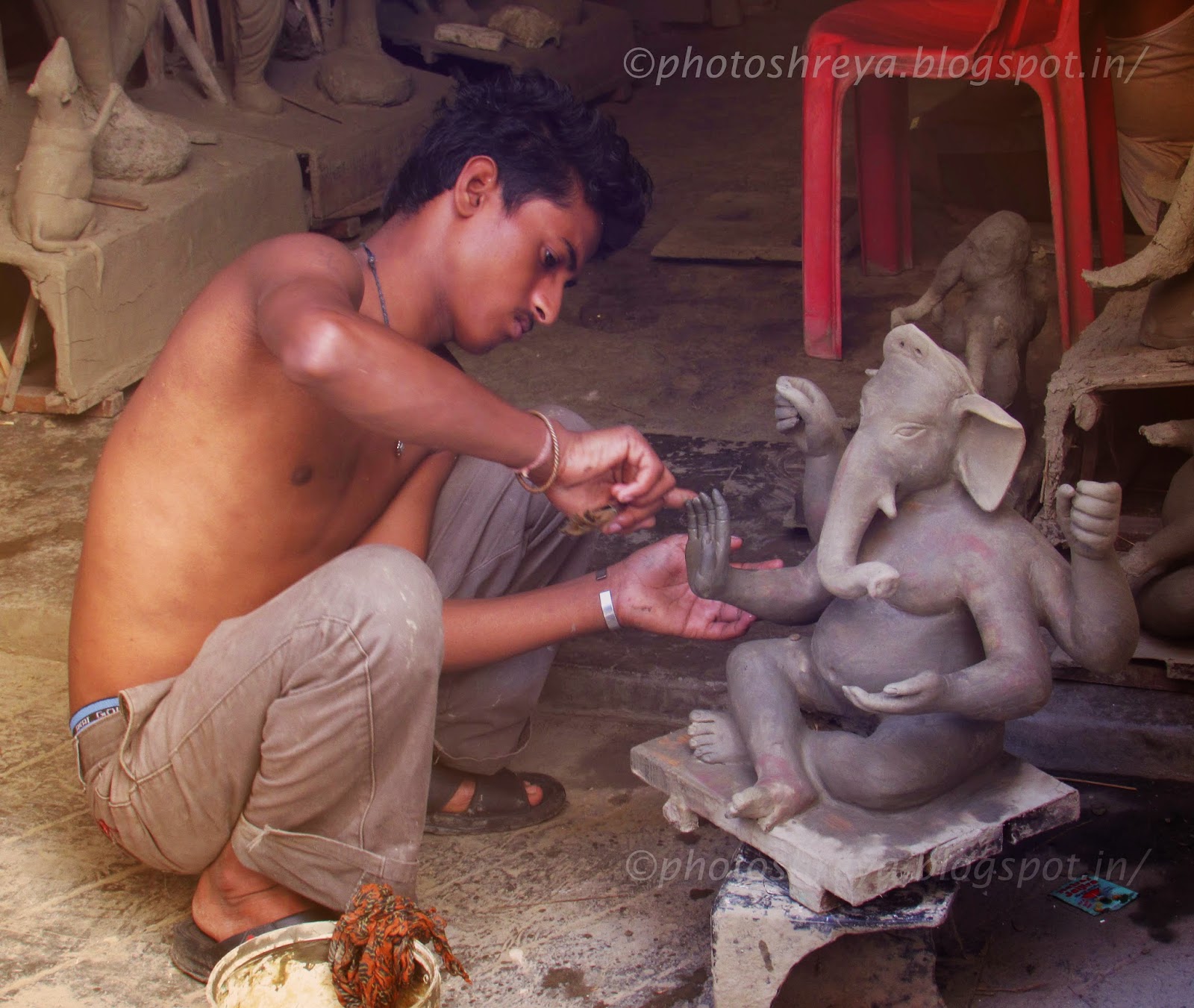
ARMS AND THE MAN
                       We headed forward, Sumit had entered a studio where an aged uncle were carving white plaster of paris and marble statues to give them perfect look. I also entered, but decided to come out to give him and Sumit some free space to talk while clicking pictures. I saw this boy working on this Ganesha idol with rapt attention in the studio, another side of the lane. 


                         This boy was working alone inside this small studio, surrounded by idol-heads, wet clay and half-made idols. The surroundings would give a nice background to our pictures, so we sat in front of the hut. Sumit asked him some questions such as whether he worked alone, how much time it took, what he does in rain etc etc. He answered some, with unusual halts, seemed that either he was too engrossed in his work or he was not happy with us visiting his studio. Even I asked some questions as per Sumit had suggested but same result.. So we came out after taking some shots. Some photographers we did not recognise, immediately entered afterwards, started taking pictured almost lying on the soil! We roamed about beside and then again entered after they were finished, Sumit again asked some normal questions but it seemed that he did not hear. Then only we understood that the poor boy had some problem with hearing as well as talking. It was saddening. 


THE STORY DOWN THE LANE

                         Have you seen the glittering ornaments of the idols? Well, this is how those are made (see the first picture above). The next one was clicked just after coming out of the hut of that poor boy. Here you can see the dingy lanes of Kumortuli, the studios built right on the lane. Imagine how they manage while it rains suddenly...They have plastic coverings beside, but the rain would already drench these clay idols..


                            Kumortuli is not only famous among the Bengalees or the non-bengalees living in West Bengal but all over the world. These foreigners had came to visit the pristine heritages in and around Kolkata, and turned up here at Kumortuli. I passed them, but Sumit insisted that I take some portraits, no matter how much I say that Portrait is not my forte. Well, these pictures made me reconsider my thoughts!! Some said, she looked imposting, some said I was supporting the fact that smoking is not injurious and the list goes on...But what do I care? I know these pictures meant neither of them, rather it was just my effort to capture some expressions turning them into portraits. She looked nice and photogenic, so I took pictures. It does not mean I have an huge attraction towards western culture, smoking and all! 


               Sumit had clicked this picture of mine while clicking the pictures of the young lady! 


                    And this is Sumit, I clicked this one when he was checking his shots (otherwise he seldom agrees to give a pose!)


                        It was my last shot while coming out of Kumortuli...This old lady sat in a Paan-stall and looked photogenic... See? I don't capture just foreigner beauties..huh!


Our next destination was Bagbazar Ghat . We sat on the ghat staircases waiting for all to turn up, then we were served hot Singara (samosa). We all talked about the experience of the photowalk, the next photowalk, the goals of the magazine, upcoming contests and all..It was the end of the day, the Sun setting over the horizon of the river, the launches passing by..A great scene to behold.


                        The aarti started at 6pm, and we sat on the staircases to capture these wonderful moments. The air was filled with intoxicating aroma of the amber incense sticks and the diyaas. The two pandits started their aarti , devoted to the river Ganga. It was tough to capture the pictures while the subjects were in motion, that too in night. I took the pictures in light mood so that the pictures come out bright, I pressed shutter continuously so that I be able to capture atleast some good moments. In utter surprise I found that some of the pictures came out really satisfying!

                      So this was the end of our photowalk, we bid adieu to the members and headed to the Bagbazar station to catch the train..exhausted but happy, this was the day well spent. Both of us enjoyed a lot after so many days without much active photography. 

Sunday, 7 September 2014

PONDICHERRY TO GOLDEN BEACH, CHENNAI

                  PONDICHERRY  and  VGP GOLDEN BEACH, CHENNAI
             It was a bright day at Pondicherry. We got up early and after finishing our breakfast headed to Sri Aurobindo Ashram, the famous spiritual community established in the Indian territory of Pondicherry (now Puducherry ) by Sri Aurobindo on 24th November, 1926. At that time there were a few disciples staying with Sri Aurobindo. Aurobindo subsequently decided to withdraw from public view for continuing his spiritual work and handed over the responsibility of the sadhakas (spiritual aspirants) and the ashram to his spiritual collaborator, "The Mother", earlier known as Mirra Alfassa.  


WAVES AT PONDICHERRY BEACH


                     In the early history of the ashram, there was a regular routine. At 6am everyday, the Mother appeared on the ashram balcony to initiate the day with her blessings. Sadhakas (spiritual aspirants), would have woken up very early and completed a good portion of the day's work including meditation and then assembled under the balcony to recieve her blessings. 
                     
                     As the ashram grew, many departments came up and were looked after by the Sadhakas (spiritual aspirants) as a part of their sadhana (worship): the offices, library, dining room, book/paragraph painting, workshops, sports/playground, art gallery, dispensary/nursing home, farms, dairies, flower gardens, guest houses, laundry, bakery etc. The heads of the departments met the Mother and took her blessings and orders. She would meet the Sadhakas individually again at 10am and in the evening at 5:30pm, she would conduct meditation and meet the Sadhakas.

                    In addition, four times a year Sri Aurobindo and the Mother used to give public Darshans (spirirtual gatherings where Guru bestows blessings) to thousands of devotees gathered to receive grace.


                           Today, Pondicherry has become an important  destination for spiritual seekers as well as tourists. Thousands of visitors from all over the world come to the ashram. When we entered, it was as if we had entered in another world, where peace prevails, where one can immerse all the sorrow and re-awake. Not only the Indians but huge number of foreign tourists were sitting on the mosaic-marble floor, deeply engrossed in spiritual books, pamphlets, some in deep thought or meditating with eyes closed.  A sanctum was nearby, with a small water body --flower petals scattered over. What a neat, tidy, peaceful, serene ashram it was! We saw the marble statue of Mother and Sri Aurobindo, in front of which, the devotees were sitting and meditating. The rooms were clean, calm and so was the library. None talked loud, people checked books, pictures, pamphlets, subscription forms etc.

                    The visiting hours for the visitors are from 8am to 12noon and then again from 2pm to 6pm. The ashram has no branch, the only one is at Pondicherry. Here is the address for your convenience : Marine St. , White Town, Puducherry 605002.  Contact no. - 0413 223 3604

                    Camera is not allowed inside or near the Ashram, so I could not click pictures. Pondicherry is anyway a very picturesque town with Portuguese buildings and beautiful lanes. After visiting the Ashram, we went to the beach beside, stayed there standing and enjoying the salty wind and sound of mild waves....then headed towards Chennai. 


                        The VGP Golden Beach is located on the Bay of Bengal in Chennai, Tamil NaduIndia. It is a major tourist attraction in Chennai. It is situated in the East Coast Road from Chennai to Cuddalore via Pondicherry. 


                      One of the most endearing attractions is the surging Bay of Bengal --a private, velvety beach with silvery sands --on the Marina, the world's second longest beach. You would hardly find any where else, an amusement park that has an enchanting sea at the backdrop.


                    The breaking of the waves and the whistling of the winds are music to the ears. It's also a safe beach where one can go for a bath or a short swim, come ashore and have a fresh water shower to cleanse. Adequate services are provided to help people enjoy.

Monday, 1 September 2014

KANCHEEPURAM -- MAHABALIPURAM

                        A VISIT TO  KANCHEEPURAM- MAHABALIPURAM

                           It was about 9:30am when we reached Chennai by the early-morning train from Bangalore. The time was the last week of October. our guide Arjun welcomed us at the station and we headed towards Mamallapuram. Mahabalipuram also known as Mamallapuram is a town in Kancheepuram district, around 60km south from the city of Chennai in Tamil Nadu .
By the 7th century, it was a  port city of South Indian dynasty of the Pallavas . It has various historic monuments built largely between the 7th and 9th century and has been classified as a UNESCO World Heritage Site . So needless to say, I was overwhelmed with excitement for the trip, but unexpectadely the rain started tremendously pouring water to my excitement! But may be the nature took pity on our excitement and after 15-20 min there was bright sunlight

THIRUKADALMALLAI , KANCHEEPURAM

                     Our first stoppage was Thirukadalmallai , a temple dedicated to Lord Vishnu , built by the Pallava king in order to safeguard the sculptures from the ocean. After building the temple, the remaining architecture was preserved and was not corroded by sea. The large entrance gate is the main attraction. A number of small tented shops were there outside the temple. Here a few cows with surprising look caught my gaze --the cows were large in size and had horns of about 3ft long. The foreign tourists were very much excited clicking pictures of those cows. A small crowd had been formed.

SHORE TEMPLE, MAHABALIPURAM

                         We had our lunch on the way to Shore Temple and Five Rathas (Pancha Pandava Rathas). The Pancha Rathas or Five Chariots are five monolithic pyramidal structures (Rathas), literally Chariots named after the Pandavas (Yudhishthira, Bhima, Arjuna, Nakula and Sahadeva) . Beside these, there is also a chariot named after Draupadi . These sculptures are complimented by some enormous stone animals including a large elephant. Dating from the 7th century, the sculptures were sculpted from the craved stones from the cliffs of the shore of the Bay of Bengal . In the Pancha Rathas, each Ratha is sculpted in a different style. The different sculptures, some half-finished, may have been examples of different styles of architecture, probably practised on by young students. An interesting aspect of the Rathas is that, despite their sizes, they are not assembled --each of these is carved from one single piece of large granite stone. The carvings are instance of the hard labour of hundreds of years. 


SHORE TEMPLE, MAHABALIPURAM


                   After the Five Rathas, we headed to the Shore Temple , the oldest structure in the area. Built in c.700 A.D. it is spread along the Bay of Bengal with the the entrance from the western side away the sea. 


BAY OF BENGAL TO THE EAST

                                 Unlike Mamallapuram's other monuments, the temple is not carved from rock, and the bulk of the current structure is a reconstruction after it was struck by cyclone. Recent excavations have revealed new structures here. 


VIEW FROM SHORE TEMPLE

                                   It's not particularly large and the carvings have been badly eroded by the salty wind and the tide, but this adds to the sense of tranquility. The area around the temple consisting a landscaped park, lush greenery and hordes of souvenir hawkers at bay enrich the beauty of the place making a huge tourist attraction.


FOREIGN FIGURES

                        The drizzles had just started then and we took shelter under a tree but that was just for a few minutes, as the rain had ceased. We came out of the shade of the tree AND was spellbound to see the rainbow formed over the sky, beneath there was the gushing deep blue sea!  It was a moment treasured...

WHERE THE RAINBOW FANCIES ON THE DEEP BLUE SEA

                  But anyway, we had to rush back to our car as the sun was biding adieu and the evening was gradually setting in. We had to cover two more places --Arjuna's Penance Bas-relief and Krishna's Butter Ball, about which I had blogged last year, when I had just started blogging! Here is the link http://photoshreya.blogspot.in/2013/07/krishnas-butter-ball-one-day-at.html